


Disclaimer: I am not an agent, nor do I have an agent myself. These are simply insights I've gleaned as I've listened in on the writing world. If you've anything to add, please post!
Via conferences, the Internet, and conversations, I've heard friends, Romans, and countrymen discuss their various books and agent experiences. It occurs to me that there are not only some common themes, but also common misconceptions. This is Part I in a series of III that attempts clarification of the Agent World.
1. Agents are human, too. Although it may seem as if they're the gatekeepers, warding you off from the inner sanctum of the Published Ones, they're all very human. They have hopes, dreams, and desires, just like you. And, oddly enough, their world doesn't revolve around you. My point? Don't take their idiosyncrasies personally. You don't know if Agent X has just found out that her mother has cancer or if Agent Y has just broken up with his girlfriend of nine years. Cut them some slack, and they're more likely to cut you some.
2. Agents want your book to be "The One." In a sense, agents are the gatekeepers. It's their job to search out the next great American novel or the next epic fantasy, and they are Desperately Seeking Susan or David or Theo. If you've done your job and sculpted that literary "intersection between art & commerce" then you're on the right track. But, if you're mewling about an agent just not appreciating your artistic execution of Banana Drying In Lavender's Window, then take a few minutes (or days) to re-evaluate. Then look for a different agent or start a different project, but don't blame your lack on the agent.
3. Agents want to work with you. More important than getting an agent is finding one who complements the person you are. If you're willing to take suggestions and/or guidance, the relationship will be mutually beneficial. If you are so "principled" that you refuse to bend on anything, you've already limited your success. Your agent wants to be excited about your project, brokering the best possible outcome for you. If your personality prevents any of that, then you best look for a different agent or an altered attitude.
Thursday, August 14, 2008


Wednesday, August 13, 2008
To Prologue or Not to Prologue
Each one of my books in The Chillwane Chronicles trilogy opens with a prologue. In my mind, a prologue provides upfront information not directly revealed in the first 50 pages; it weaves an element of continuity through the three books; and, frankly, it provides an instant tinge of mood. Now, I don't pen lengthy prologues. I figure (and this is just me) that if I can't say it in a page or less, then it needs to be part of the exposition or wiggled into the conflict.
Minju Chang, an agent with BookStop Literary Agency since 2006, disagrees. There are few times when a prologue is needed, she says. When she looked over the opening pages of my manuscript, she asked pointed questions about the purpose of the prologue. To my credit, I think I defended its existance adequately enough. But I can't thank her enough for her willingness to be that difficult combination of sharply critical and graciously kind.
Because, ultimately, the prologue didn't matter. I tucked my tail, sidled into my study, and took a good, long, hard look at each one of the prologues. And deleted them. Even though I had initially thought them integral to the story, each was entirely dispensible. Minju was right. And thanks to her insight, I have a stronger beginning: more solid, more impact.
Tuesday, August 12, 2008
Calling All Young Adult Fantasy Writers!
Although a previous blog mentioned briefly Mirrorstone, the children's/young adult imprint of Wizards of the Coast (distributed by Random House, Inc), I'd like to expand on that in today's thoughts.
Mirrorstone, once a place where you could propose series or standalone books of your own in the YA fantasy category, "will now focus solely on books inspired by the lore of Dungeons and Dragons, such as the Dragon Codex books and The New York Times best-selling Practical Guide series." Stacy Whitman, an editor at Mirrorstone, posted on her August 8th blog some of the changes facing Mirrorstone, though you can also check them out directly on the Mirrorstone website.
So the question is: good or bad news? Ultimately, it's a smart move on the part of Wizards of the Coast. By focusing on their brand name (Dungeons and Dragons) and clearing the table of anything that could blur that venture, they're committing all their resources and energy to what puts them on the book, so to speak. It's also good news for D&D (and Forgotten Realms, etc) fans because a tauter focus leads to an overall better product, better writers, better adventures.
Finally, I think it's a golden opportunity for the aspiring writer. To mangle the old proverb, "Blood will out," good writing will out. In other words, if you've got the ability to write, the stamina to see it through, and the desire to get your feet wet, send in a writing sample. They're looking for "talented writers" to continue the series lines, and this is your golden opportunity to prove you've got what it takes.
An Aside: Practice makes perfect. It occurs to me that all too often we writers baby our egos. We're not always willing to admit (as so many famous authors before us have) that we may need to write a couple of novels before we're where we want -- or need -- to be as writers. Writing someone else's story takes not only discipline but a steely resolve to keep your characters in line and your setting in keeping with the established world. Think on it.
Monday, August 11, 2008
When Goliath Doesn't Fall by Jody Conrad
[Note: A continuation of the up & coming series on new authors.]
Sometimes, no matter how hard you pray, babies dies. Sometimes, no matter how much you trust God, doctors find cancer. Houses catch on fire; tornados demolish entire communities; and terrorists successfully crash airplanes into buildings.
 Jody Conrad's first book, out in 2008 and entitled When Goliath Doesn't Fall, asks the question What happens to our faith when our giants defeat us? Weaving true life stories with historical and biblical ones, and generously interspersed with gentle wisdom, Conrad strikes a balance between insight and compassion. A book of hope, When Goliath Doesn't Fall delicately probes the questions believers often feel guilty about asking God and lays bare the souls of those who have been answered.
Encouraging, thought-provoking, and always empathetic, Conrad provides the only answers possible to these questions: a Habakkuk heart, unconditional surrender, and a yielded spirit. Her own gentleness pulls back the curtains in a way that doesn't preach or nag but only reminds that God is in control.
Sometimes, no matter how hard you pray, babies dies. Sometimes, no matter how much you trust God, doctors find cancer. Houses catch on fire; tornados demolish entire communities; and terrorists successfully crash airplanes into buildings.
Jody Conrad's first book, out in 2008 and entitled When Goliath Doesn't Fall, asks the question What happens to our faith when our giants defeat us? Weaving true life stories with historical and biblical ones, and generously interspersed with gentle wisdom, Conrad strikes a balance between insight and compassion. A book of hope, When Goliath Doesn't Fall delicately probes the questions believers often feel guilty about asking God and lays bare the souls of those who have been answered.Encouraging, thought-provoking, and always empathetic, Conrad provides the only answers possible to these questions: a Habakkuk heart, unconditional surrender, and a yielded spirit. Her own gentleness pulls back the curtains in a way that doesn't preach or nag but only reminds that God is in control.
Sunday, August 10, 2008
Terry Brooks: Genesis of Shannara
As a writer, it's almost cathartic to see the connections between events, the spiderweb-thin threads that weave us and our experiences of one another together. It is also humbling to realize that each of us is just one of 6.8 billion on planet Earth.
Connection 1: Just about a year ago, when I contacted Terry Brooks via his website to ask him to be the keynote speaker at our small, local Young Authors' Conference, I received a kind email from his manager: Terry Brooks is feverishly finishing his next novel. Not even his family is seeing him right now.
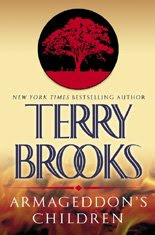 Connection 2: Fast forward a year. The Gypsy Morph, third and final book of the Genesis of Shannara trilogy, won't be out until August 26th, 2008. Imagine my surprise when, at the final event of this summer's PNWA conference, we all receive a free copy of Terry Brooks' Armageddon's Children, the first book in the Genesis trilogy which, in a simplified nutshell, spans the gap between the Shannara and the Word & Void books.
Connection 3: The News? The book was a teaser, designed to whet the appetite. So, save up your frequent flyer miles! Terry Brooks will be the keynote speaker at the July 2009 Pacific Northwest Writers Association Summer Conference.
Churning out a novel a year, Terry Brooks has an entire novel finished by the time the current one goes to print. Whether you love him or hate him, Brooks is a titan of the fantasy world, intent upon retaining the crown of authorship.
Connection 1: Just about a year ago, when I contacted Terry Brooks via his website to ask him to be the keynote speaker at our small, local Young Authors' Conference, I received a kind email from his manager: Terry Brooks is feverishly finishing his next novel. Not even his family is seeing him right now.
Connection 2: Fast forward a year. The Gypsy Morph, third and final book of the Genesis of Shannara trilogy, won't be out until August 26th, 2008. Imagine my surprise when, at the final event of this summer's PNWA conference, we all receive a free copy of Terry Brooks' Armageddon's Children, the first book in the Genesis trilogy which, in a simplified nutshell, spans the gap between the Shannara and the Word & Void books.Connection 3: The News? The book was a teaser, designed to whet the appetite. So, save up your frequent flyer miles! Terry Brooks will be the keynote speaker at the July 2009 Pacific Northwest Writers Association Summer Conference.
Churning out a novel a year, Terry Brooks has an entire novel finished by the time the current one goes to print. Whether you love him or hate him, Brooks is a titan of the fantasy world, intent upon retaining the crown of authorship.
Saturday, August 9, 2008
James Merrill Writer-in-Residence Program
Serious about writing? Have muse firmly in hand, but no space to let her dance? Consider applying to the James Merrill Writer-in-Residence Program in Stonington, CT. You can apply for either a five-month or an eleven-month residence in which you work and live rent-free in the apartment Merrill left to the village of Stonington. The only requirement is that you complete a project of literary or academic merit and that you contribute in some way to the community life of Stonington.
Although the program has been in place since 1995, this is the first year that a stipend will also be granted, with a $5000 stipend awarded for the five-month term and a $10,000 stipend awarded for the eleven-month term. Applications for 2009-10 are due January 15, 2009
Although the program has been in place since 1995, this is the first year that a stipend will also be granted, with a $5000 stipend awarded for the five-month term and a $10,000 stipend awarded for the eleven-month term. Applications for 2009-10 are due January 15, 2009
Subscribe to:
Posts (Atom)

 Posts



